



Lancashire has presented the government with five competing visions for how the county’s local authority map should be redrawn – in what will be the biggest council overhaul in more than 50 years.
The 15 main authorities in the area were responding to a call from ministers to set out by Friday (28th November) the number, size and shape of the councils that should replace them when the existing crop are all axed in 2028.
They each made submissions – three of which were shared by different groups of councils working together – outlining their preferred outcome for the government-ordered revamp. In the process, the authorities produced almost 900 pages of argument between them in the form of business cases promoting the claimed benefits of their chosen option.
Although they back different blueprints for how they hope the shake-up will shake down, the county’s existing council leaders all signed a joint covering letter to local government secretary Steve Reed, collectively lodging their proposals.
That united front served to signify that the authorities had co-operated in the development of the contrasting plans that they had put forward – by basing each of their business cases on the same core data, which was specially commissioned to underpin the process and prevent any fallings out over facts.
However, the 15 nevertheless then came up with five completely different interpretations of what the statistics suggested was the best way ahead – with the letter acknowledging the continued lack of “consensus” on the new council cartography, almost 12 months after ministers set the changes in motion.
The correspondence also provided an opportunity for the leaders to jointly argue for “targeted financial support” from the government to help meet the cost of the redesign, which could top £100m – and which would otherwise have to be funded through the reserves of the existing councils.
The Local Democracy Reporting Service (LDRS) understands that several councils also sent their own supplementary letters, both to bolster their own business cases and also to request the cancellation of next year’s local elections in some of the seven areas of Lancashire where they are scheduled to take place.
The government has stated that elections to ‘shadow’ versions of the new authorities will be held in May 2027, ahead of the councils formally coming into being on 1st April, 2028.
However, as part of its submission, Lancashire County Council has requested that the shadow elections be delayed until at least May 2028 – with the launch date for the new authorities pushed back until 2029 at the earliest – amid concerns over the stability of key services if the government proceeds with its planned timetable.
In a survey of public opinion carried out across the county in September, almost two thirds of the more than 13,000 respondents said they would prefer the current council system to remain in place – with the same proportion declaring that they were content with the services that the existing authorities provided.
That fact was noted at a meeting of the county council’s cabinet on Thursday afternoon, when the authority was amongst the last of the 15 to ratify its own position on the form the new arrangements should take – backing a straight north-south split, cutting Lancashire in two, essentially along the River Ribble.
However, the gathering struck a downbeat note about the process Lancashire was being put through by the government, which the authority’s Reform UK leader, Stephen Atkinson – a longstanding opponent of local government reorganisation – said should have been the subject of a legally-binding referendum that residents had been denied by ministers.
He added: “This is a really sad day for me and many Lancastrians, [that on what is] Lancashire Day…we’d actually vote to end 136 years of Lancashire County Council history.”
However, County Cllr Atkinson said he believed the county council’s chosen option for the new local authority set-up would eliminate the “postcode lottery for services and care” in the county by creating councils with “balanced resources”.
Opposition Progressive Lancashire group leader Azhar Ali – although supportive of the principle of moving to unitary authorities – said he feared the business cases sent to the government would be examined “from a political angle” – and that ministers would know “exactly what they’re going to do” regardless of any consultation.
The government has indicated that it would like the new council areas to serve populations of at least 500,000 residents, but is willing to make exceptions in places where that number “does not make sense”. The majority of the scenarios proposed by Lancashire create authorities that come in below the half-a-million threshold.
Meanwhile, deputy Progressive Lancashire leader – and Green party group leader – Gina Dowding told the cabinet meeting that “the approach” taken by the new councils would be key to their success, highlighting the need for them to be “flexible, adaptable and rapid” in responding to the challenges they will face.
WHAT IS CHANGING?
The overhaul will end the so-called ‘two-tier’ system that operates across most of Lancashire, under which responsibility for different services is split between Lancashire County Council and the dozen district authorities – Preston, South Ribble, Chorley, West Lancashire, Fylde, Wyre, Lancaster, Ribble Valley, Burnley, Hyndburn, Rossendale and Pendle.
County Hall looks after the likes of roads, transport, social care and schools, while the districts are responsible for services including waste collection, most planning applications, housing and parks.
The new arrangement will create a handful of standalone – or ‘unitary’ – authorities that deliver all local services in their areas, just like Blackpool and Blackburn with Darwen councils do already.
All of Lancashire’s 15 local authorities will be abolished on 31st March, 2028. The current set-up – save for when Blackpool and Blackburn with Darwen became unitaries in 1998 – has been in place in Lancashire since the last major shake-up in 1974.
WHAT HAPPENS NEXT?
The government will consider the five options suggested by Lancashire and create a shortlist on which a formal public consultation will be carried out in the early months of next year.
A final decision is then expected to be taken next summer, setting in train what will be just under two years of highly complex transitional arrangements.
During that period, the existing councils will be responsible for the delivery of services right through until their final day of operation, while their replacements will be preparing to take over. However, the new authorities – albeit in ‘shadow’ form – will have to be consulted over any major spending or borrowing decisions the current councils want to make during their remaining time in operation.
WHO WANTS WHAT?
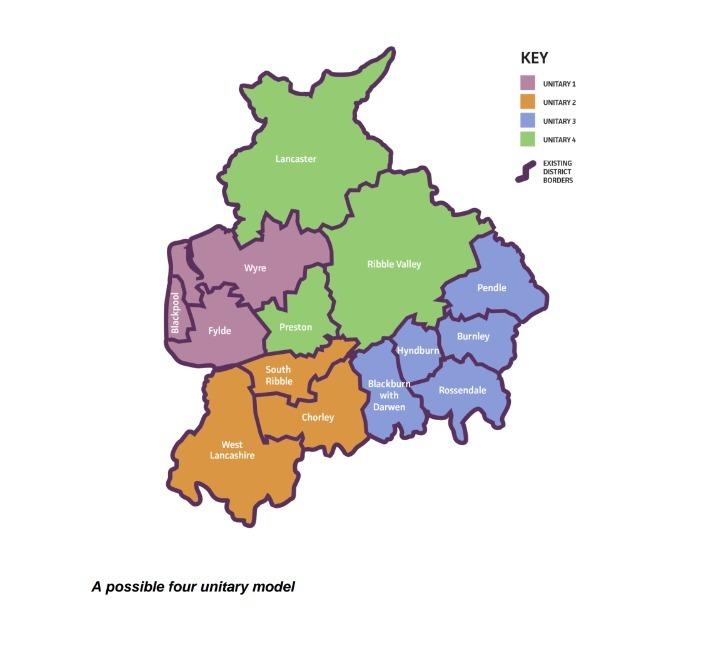
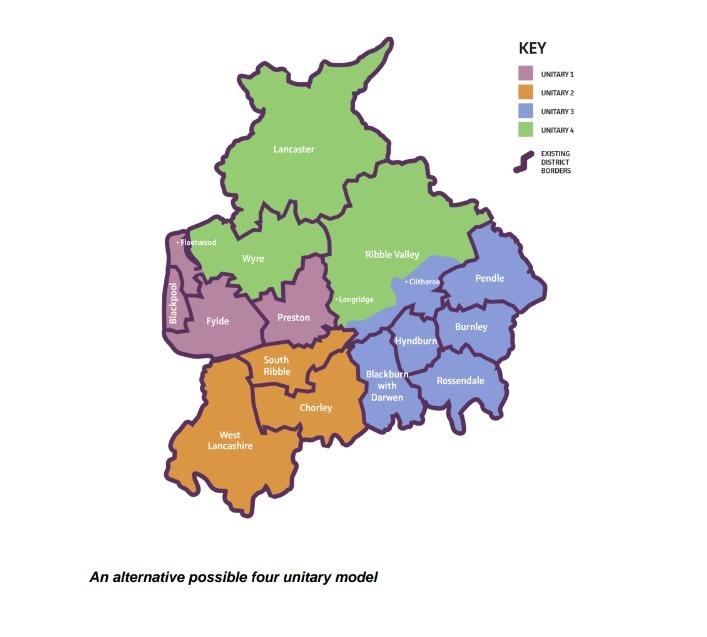
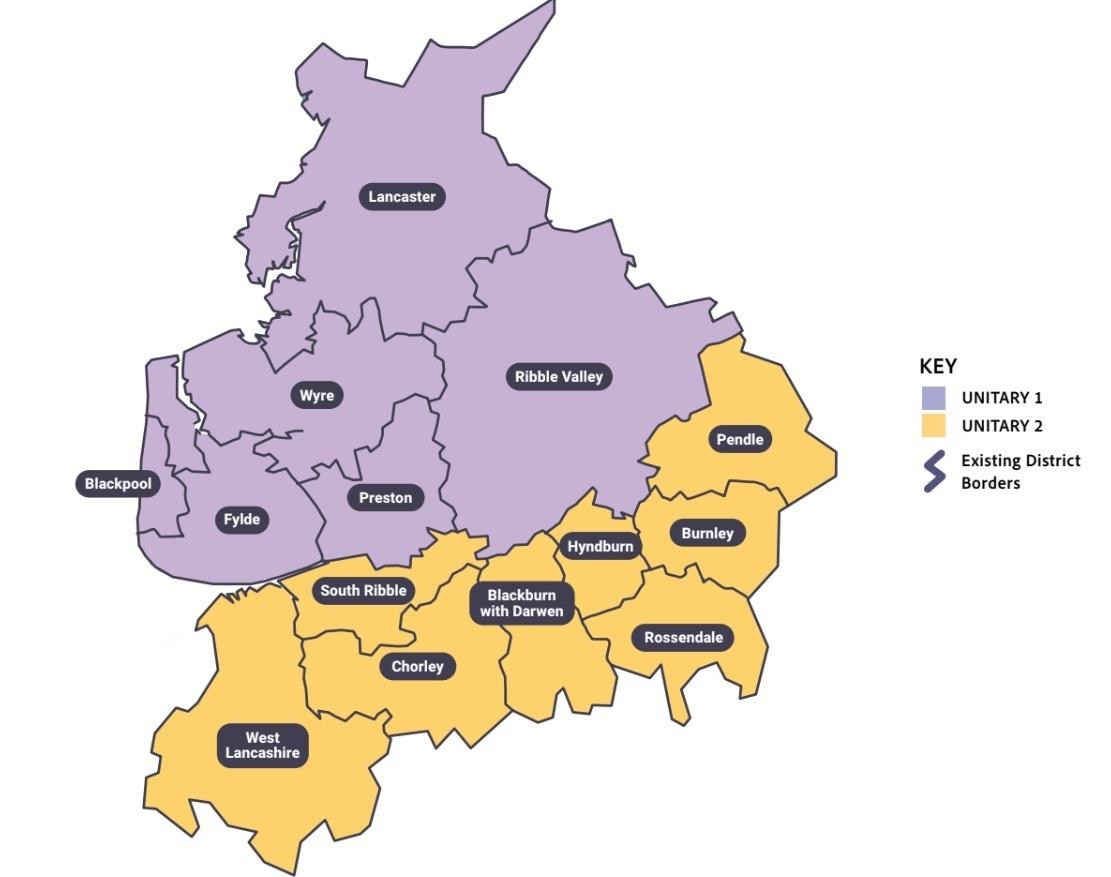
These are the arrangements that each of the existing councils have requested the government implement in order to create a new-look Lancashire – showing which council areas would merge and how many residents would be served by the new authorities in each area:
Two new councils
Council 1: Blackpool, Fylde, Lancaster, Preston, Ribble Valley and Wyre (722,045 residents)
Council 2: Blackburn with Darwen, Burnley, Chorley, Hyndburn, Pendle, Rossendale, South Ribble and West Lancashire (879,510 residents)
Promoted by: Lancashire County Council
Three new councils
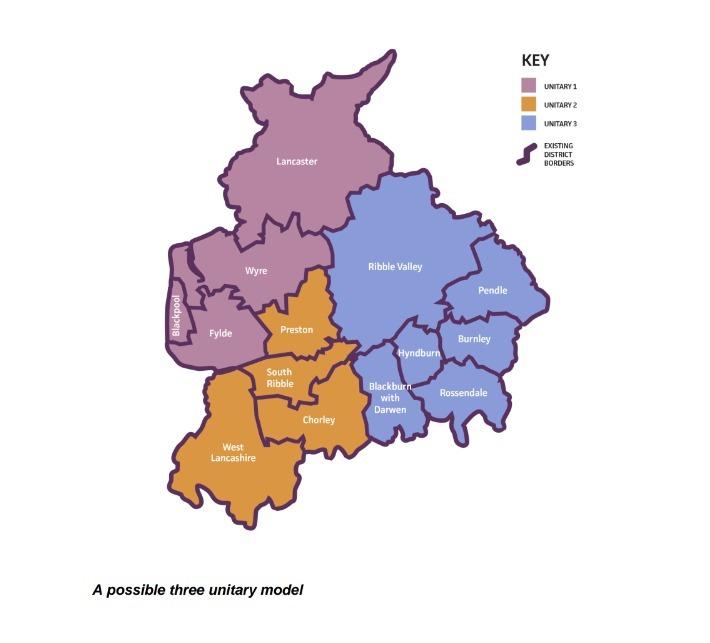
Council 1: Blackpool, Fylde, Lancaster and Wyre (493,387 residents)
Council 2: Chorley, Preston, South Ribble and West Lancashire (521,811 residents)
Council 3: Blackburn with Darwen, Burnley, Hyndburn, Pendle, Ribble Valley and Rossendale (586,357 residents)
Promoted by: Blackburn with Darwen, Fylde, Hyndburn, Rossendale and Wyre councils
Four new councils (version 1)
Council 1: Blackpool, Fylde and Wyre (348,381 residents)
Council 2: Chorley, South Ribble and West Lancashire (358,947 residents)
Council 3: Blackburn with Darwen, Burnley, Hyndburn, Pendle and Rossendale (520,563 residents)
Council 4: Lancaster, Preston and Ribble Valley (373,664 residents)
Promoted by: Chorley, Lancaster, Preston, Ribble Valley, South Ribble and West Lancashire councils
Four new councils (version 2)
Council 1: Blackpool, Fylde, Preston and western Wyre (475,222 residents)
Council 2: Chorley, South Ribble and West Lancashire (358,947 residents)
Council 3: Blackburn with Darwen, Burnley, Hyndburn, Pendle, southernmost Ribble Valley and Rossendale (565,968 residents)
Council 4: Lancaster, most of Ribble Valley [excluding Clitheroe and southernmost areas] and eastern and northern Wyre (201,508 residents)
Promoted by: Blackpool Council
Five new councils
Council 1: Blackpool, Fylde and Preston (348,381 residents)
Council 2: Chorley, South Ribble and West Lancashire (358,947 residents)
Council 3: Blackburn with Darwen, Hyndburn, Ribble Valley (314,302 residents)
Council 4: Lancaster and Wyre (263,749 residents)
Council 5: Burnley, Rossendale and Pendle (272,055 residents)
Promoted by: Burnley and Pendle councils


Share